Saturday, 14 November 2015

Abraham's Temptation: a matter of Faith, Hope and Love

Thursday, January 22, 2009, 11:12 AM
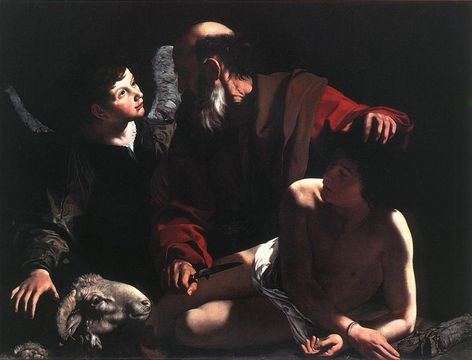

The Sacrifice of Isaac, Caravaggio, 1598

God's Covenant with Abram (Genesis 15) is a real proper Covenant, that is bilateral (NOT unilateral), with the added specification that it is asymmetric.
.
It is a sign of great confusion to resort to the philosophical lucubrations of a secular philosopher, however great, like Immanuel Kant ...
"If God should really speak to man, man could still never know that it was God speaking. It is quite impossible for man to apprehend the infinite by his senses, distinguish it from sensible beings, and recognize it as such. But in some cases man can be sure the voice he hears is not God’s. For if the voice commands him to do something contrary to moral law, then no matter how majestic the apparition may be, and no matter how it may seem to surpass the whole of nature, he must consider it an illusion." --Immanuel Kant, in The Conflict of the Faculties, p. 115

... and to oppose them to the totally unambiguous and crystal clear text of the Bible (Gen 22:1-2; 15-18)
.
Abraham's Trial is a true trial (test, temptation) of Abraham by God, to test his faithfulness to the Covenant and his obedience to the LORD (see previous post Abraham's Temptation: only a matter of Faith, or also of Hope?)
"There is definitely an implied requirement that Abraham have faith in God, and that is all that is required to have a mutual agreement, a covenant"
Genesis 22:2, as well as Genesis 22:16-18 are to be read at face value, viz. as a command that the Lord actually gave to Abraham, and as God's approval of Abraham for "passing the test" as even simply prudent ex-exesis would dictate.
.
The Covenant that God established with Abram/Abraham (once again, bilateral, with the added specification that it is asymmetric) assumes the form of the ancient rite of “covenant between the pieces” (see Genesis 15). God's commitment is unconditional on His part: the LORD is the only one who "walks between the pieces" and who, paradoxically, pledges Himself symbolically to be "cut in half" if He does not keep his promise.
.
While God's commitment to the Covenant is unconditional, this does not imply that there are not obligations for Abraham. They are summed up as faithfulness to the covenant and obedience to an explicit command of God, which is a true an proper "stipulation for Abram: “I am God Almighty; [Hbr: El Shaddai] walk before me [“serve me faithfully”] and be blameless ...” (Genesis 17:1) and is expressed symbolically by the circumcision 
.
Abraham's feeling of 'obligation' when he is "put to the test", that is, his motivation for being ready to sacrifice his own son has nothing whatsoever to do with a presumed "predisposition ... originated in his own mind from his culture" and "inclinations based on his cultural background". In particular Abraham was not mislead by a supposed "ill-inspired initiative to please the LORD", adopting the idolatrous and deviated sacrificial practices in existence in the land where he came from ("Ur of the Chaldeans"), transited through (Haran, Egypt) and eventually settled in (Canaan) where human sacrifice, and in particular the sacrifice of children was practiced.
.
The LORD had gradually established in and with Abram/Abraham, by the time of His Temptation, enough trust to expect that Abraham would respond in the only possible way, however anguishing, that is with obedience. Abraham proved by his behaviour that he had enough Love (that is obedience) for God and, at the same time for his son Isaac (the "son of the promise", whom he owed entirely to God's miraculous intervention) to respond to God's request with Faith and Hope. (see previous post Abraham's Temptation: only a matter of Faith, or also of Hope?)
.
God did NOT lie to Abraham about his request of sacrifice: he ONLY affirmed His own right to test, in His Omnipotence, even Abraham's readiness to offer his own child Isaac (who, again, was entirely the fruit that Abraham owed to God's miraculous intervention): it was a a true trial (test, temptation), and God could rightfully assume that Abraham had, by then, acquired enough Faith and Hope in Him to "take the risk" of Obeying unconditionally.
.
Genesis 15 and Jeremiah 34:18,19 are the most relevant (and specular) examples of bilateral Covenant in the OT, where God and humans are involved (see SMITH comment on "Covenant" at NETBible). In the former it is the LORD who pledges Himself unconditionally, ONLY God "passed between the pieces". In the latter it is the "the leaders of Judah and Jerusalem, the court officials, the priests, and all the other people of the land", ONLY men "passed between the parts of the calf" "before God".
.
Abraham, who was faithful ad obedient to God like a servant, did NOT behave with the motivations of a servant, but out Faith,  Hope and  Love. That is why he is, rightfully, the only one to be called "friend of God"(James 2:21-23)
.
That Abraham responds with Faith and Hope  to the request of the LORD to offer Isaac in sacrifice as a test, is confirmed beyond doubt by this fundamental verse: Then Abraham said to his young men, “Stay here with the donkey; I and the boy will go over there and worship and come again to you.” (Gen 22:5) (#)
.
That "Abraham's Trial" is a genuine trial (test, temptation) both for God who initiates it, and for Abraham who responds to it, depends essentially on the fact that Abraham enjoyed genuine human freedom, which would have been incompatible with God's absolute foreknowledge.
.
Abraham's faithfulness and obedience truly express themselves in Abraham's response to God's request, that is in his offer to sacrifice his son Isaac.

NOTE
(#) Some have interpreted this passage of Hebrews ...
17 By faith Abraham, when he was tested, offered up Isaac, and he who had received the promises was in the act of offering up his only son,   18 of whom it was said, “Through Isaac shall your offspring be named.”  19 He considered that God was able even to raise him from the dead, from which, figuratively speaking, he did receive him back. (Heb 11:17-19)
... to mean that, if ever God had indeed required Isaac’s death, God would have returned Isaac to Abraham by way of resurrection.
While I am perfectly aware of what the author of Hebrews says, it is definitely far-fetched to attribute to Abraham the belief that, if the Mysterious God really  wanted him to go all the way with the sacrifice (slaughtering his son Isaac and burning him to ashes), he overcame that thought, because "He considered that God was able even to raise him from the dead".
There is no serious ground to infer that, at that initial stage of God's revelation, Abraham could possibly think of the resurrection of the dead.
It is evident that this is ONLY a rhetoric figure, on the part of the author of Hebrews, so as to introduce the second (and most relevant) part of the verse: "from which [the dead], figuratively speaking, he did receive him back." (Hebrews 11:9).
The author of Hebrews is clearly speaking in figure: what he is saying is that it is as though Abraham, through his faith and his obedience, approved by God (Gen 22:12,16), had received Isaac back, because only "hoping against hope" could he possibly "know" that God would have stopped short of letting him go through with the sacrifice.
To understand the essential role of hope in Abraham's Trial, Paul, with his Epistle to the Romans is of much more help than the Epistle to the Hebrews:
 In hope he [Abraham] believed against hope, that he should become the father of many nations, as he had been told, “So shall your offspring be.” (Romans 4:18 - ESV - emphasis MdS)

Three verses of Matthew on the Coming of the Son of Man

Tuesday, January 20, 2009, 6:53 PM


1. Matthew 16:28, "Truly, I say to you, there are some standing here who will not taste death until they see the Son of Man coming in his kingdom.”

2. Matthew 10:23, "When they persecute you in one town, flee to the next, for truly, I say to you, you will not have gone through all the towns of Israel before the Son of Man comes."

3. Matthew 24:34 "Truly, I say to you, this generation will not pass away until all these things take place."


1. Jesus knows what lies ahead for him, so much so that, immediately after Peter has proclaimed that he is the Messiah, he bids all present to total silence, announces that his way will be, contrary to to common Messianic expectations (not Isaiah's prophecies of the Suffering "Servant of the LORD", though, see Isaiah 42:1-7; 49:1-13; 50:4-11; 52:13-53:12 ...) the way of persecution, of the cross, of an ignominious death.

It is as some sort of compensation for the fact that the First Coming will not satisfy the Messianic expectations (or rather it will satisfy them in a paradoxical, totally unexpected way) that Jesus, as a support for the faith of the "Columns of the Church", Peter, James and John, takes them with himself and lets them partake of the Transfiguration (Matthew 17:1-13; cp. Mark 9:2-13, Luke 9:28-36)

The Transfiguration is a foretaste of the Second Coming.

2. This is before Peter's Messianic Confession at Caesarea Philippi. "Son of Man" is an expression which is used in the Gospel more than Messiah or Christ (84 times vs. 63 times). Besides, while Jesus often openly refers to himself as the "Son of man", he NEVER openly referrent to himself as the Messiah/Christ, other than on two occasions only: once in private, in front of the Samaritan woman (John 4:25-26); the second, and dramatically decisive one, in front of Caiaphas and the Sanhedrin (Matthew 26:63-64), when he identified himself as the Messiah/Christ and, at the same time proclaimed that the expression "Son of man" was not generic, but made reference precisely to the messianic figure of the "Son of man" of Daniel 7:13-14.

The Messiah/Christ and the "Son of man" are one and the same.

3. The original Greek translated with the English "this generation" is γενεα αυτη (genea autē), where autē does NOT  mean "this one here, in front of me" BUT "this same one", [that will witness all the signs that I have spoke about] and in particular these signs:
The Coming of the Son of Man

29 “Immediately after the tribulation of those days the sun will be darkened, and the moon will not give its light, and the stars will fall from heaven, and the powers of the heavens will be shaken. 30 Then will appear in heaven the sign of the Son of Man, and then all the tribes of the earth will mourn, and they will see the Son of Man coming on the clouds of heaven with power and great glory. 31 And he will send out his angels with a loud trumpet call, and they will gather his elect from the four winds, from one end of heaven to the other. (Matthew 24:29-31)
The Second Coming will happen within the span of a generation from the signs that announce it.

The Apostles' Creed, the Old Roman Symbol and the Cappadocian scoundrels

Wednesday, January 14, 2009, 11:50 AM


Origin of the Apostles Creed

"Throughout the Middle Ages it was generally believed that the Apostles, on the day of Pentecost, while still under the direct inspiration of the Holy Ghost, composed our present Creed between them, each of the Apostles contributing one of the twelve articles. This legend [sic! bias!] dates back to the sixth century (see Pseudo-Augustine in Migne, P.L., XXXIX, 2189, and Pirminius, ibid., LXXXIX, 1034), and it is foreshadowed still earlier in a sermon attributed to St. Ambrose (Migne, P.L., XVII, 671; Kattenbusch, I, 81), which takes notice that the Creed was "pieced together by twelve separate workmen". About the same date (c. 400) Rufinus (Migne, P.L., XXI, 337) gives a detailed account of the composition of the Creed, which account he professes to have received from earlier ages (tradunt majores nostri). Although he [Rufinus] does not explicitly assign each article to the authorship of a separate Apostle, he states that it was the joint work of all, and implies that the deliberation took place on the day of Pentecost. ...

[Passage where it is explained that Rufinus was the first to refer to the Creed that he attributed to the direct authorship of the apostles with the expression " Symbolum Apostolorum" ("Creed of the Apostles")]

... Rufinus was therefore wrong when he declared that the Apostles themselves had "for many just reasons" selected this very term [symbolum]. This fact, joined with the intrinsic improbability of the story, [sic! bias!] and the surprising silence of the New Testament and of the Ante-Nicene Fathers, leaves us no choice but to regard the circumstantial narrative of Rufinus as unhistorical"
[Catholic Encyclopedia, Apostles' Creed, Origin of the creed, first paragraph]
a. While the story that each of the 12 Apostles contributed a line of the Apostles’ Creed smacks of pious legend, to call the tradition of the genuinely Apostolic origin of the Apostles’ Creed a “legend” is manifest bias.

b. The reference of Rufinus (to whom we owe the first exposition of the Old Roman Symbol in Latin) to the Creed as Symbolum Apostolorum ("Creed of the Apostles") is considered by the author of the article of the Catholic Encyclopedia “wrong” on the weak account that, “in the first two centuries after Christ, though we often find mention of the Creed under other designations (e.g. regula fidei, doctrina, traditio), the word symbolum does not occur”.

c. Rufinus' exposition of the Old Roman Symbol (in Latin, circa 400 AD) is NOT the first, absolutely speaking. It is attested in Greek by the letter that Marcellus of Ancyra wrote to Pope Julius I on the occasion of a Synod held in Rome in 340 AD, to prove that the creed he held (and with him the whole Church of Asia Minor, viz. Anatolia, viz. modern day Turkey) was conforming to the one held in Rome. (see quotations ahead)

 The Apostles' Creed "in its present form" (known to scholars as Textus Receptus, "Reveived Text") became the universal standard of Western Christianity since the 7th, nay 8th century.

The Apostles' Creed, though, is much, much older: the s.c. "Old Roman Symbol" (which goes back to the 2nd century) is essentially indistinguishable from the Apostles' Creed in its present form, apart from few differences which are possibly later additions, and have very little bearing on its essence.

Herebelow I have put in italics and [square parentheses] the parts of the Apostles' Creed that do not appear in the Old Roman Symbol.

The Old Roman Symbol vs. the Apostles Creed [§]

I believe in God, the Father almighty, [creator of heaven and earth.]
I believe in Jesus Christ, God's only Son, our Lord,
who was [conceived] by the Holy Spirit, born of the Virgin Mary,
[suffered] under Pontius Pilate, was crucified, [died], and was buried;
[He descended to the dead.] On the third day he rose again;
He ascended into heaven, he is seated at the right hand of the Father,
and he will come again to judge the living and the dead.
I believe in the Holy Spirit,
the holy [catholic] Church, [the communion of saints,]
the forgiveness of sins,
the resurrection of the body,
and the life everlasting. [§]
[Amen.]

[§] The Old Roman Symbol is attested in two versions (one in Greek and the other in Latin), both from the 4th century (the same time when the original Nicene Creed of 325 AD, then the Nicene-Constantinopolitan Creed 381 AD were established): the one in Greek by Marcellus of Ancyra; the other, in Latin, by Tyrannius Rufinus (aka Rufinus of Aquileia). The two versions are "faithful, literal, verbatim translations of each other. The only outstanding difference is the concluding clause in the Greek text, ζωὴν αἰώνιον ([zoèn aionion] "life everlasting"), which has no equivalent in the Latin text. This clause is present in the Apostles' Creed."
Although the Apostles' Creed is not used, nowadays, in the Eastern Orthodox liturgy, nevertheless it would be wrong to affirm that the Apostles' Creed (to be accurate in its earlier version, essentially identical to the Old Roman Symbol) "has never been part of the liturgical tradition of the Eastern Orthodox". It certainly was at the time of Marcellus of Ancyra, well into the 4th century, as attested by the letter that he wrote to Pope Julius I on the occasion of a synod held in Rome in 340 AD, to prove that the creed he held (and with him the whole Anatolian Church) was conforming to the one held in Rome. Here is what Marcellus of Ancyra wrote to Pope Julius I:

"I though it necessary ... to write down faithfully in my own hand and to deliver to you my faith (την εμαυτου πιστιν), which I learned and was taught out of the holy Scriptures" ...

... and along with this his remark towards the end of the letter ...

"This is the faith (ταυτην την πιστιν) which I received from the holy Scripture, which I was taught by my parents in religion, and which I preach in the Church of God".

-- J.N.D. Kelly, [1950] (2006) Early Christian creeds, 3rd ed., London : Continuum, ISBN 0-82649-216-9, page 108

Only by an unfortunate (maybe not only unfortunate ...) series of circumstances, the Apostles' Creed, the only genuinely Apostolic Creed, which until the 4th century was (with minimal variants) adopted throughout all Christian Churches, East and West, received the following, devastating, spurious, heathen-philosophical additions:

Nicene Constantinopolitan metaphysical additions

[Jesus Christ] eternally begotten of the Father,
God from God, Light from Light, true God from true God,
begotten, not made, of one Being with the Father.
Through him all things were made.

[The Holy Spirit], the Lord, the giver of life,
who proceeds from the Father and the Son.
With the Father and the Son he is worshipped and glorified.

With these additions, the Church essentially gave in to the magic formula of the Cappadocian scoundrels:
 “"three persons/subsistencies (hypostases) in one essence (ousia)"” 
A form of verbal idolatry, closely matched by the parallel visual idolatry TrinityShield_300.jpg

A possible "harmony" between Luke's and John's account of Jesus Burial

Friday, March 6, 2009, 11:35 AM


Photographic negative of the face on the Shroud of Turin

Let’s look closely at The Burial of Jesus, concentrating on Luke as representative of the three Synoptics, on one side, and on John, on the other side. These are the relevant passages, respectively

Jesus’ Burial [Luke-synoptic]

50 Now there was a man named Joseph who was a member of the council, a good and righteous man. 51 (He had not consented to their plan and action.) He was from the Judean town of Arimathea, and was looking forward to the kingdom of God. 52 He went to Pilate and asked for the body of Jesus. 53 Then he took it down, wrapped it in a linen cloth [sindon], and placed it in a tomb cut out of the rock, where no one had yet been buried. 54 It was the day of preparation and the Sabbath was beginning. 55 The women who had accompanied Jesus from Galilee followed, and they saw the tomb and how his body was laid in it. 56 Then they returned and prepared aromatic spices and perfumes [or “ointments”].

On the Sabbath they rested according to the commandment. (Luke 23:50-56)

Jesus’ Burial [John]

38 After this, Joseph of Arimathea, a disciple of Jesus (but secretly, because he feared the Jewish leaders), asked Pilate if he could remove the body of Jesus. Pilate gave him permission, so he went and took the body away. 39 Nicodemus, the man who had previously come to Jesus at night, accompanied Joseph [N.B. the text ONLY says êlthen, "arrived"], carrying a mixture of myrrh and aloes weighing about seventy-five pounds. 40 Then they took Jesus’ body and wrapped it, with the aromatic spices, in strips of linen cloth [othonia] according to Jewish burial customs. 41 Now at the place where Jesus was crucified there was a garden, and in the garden was a new tomb where no one had yet been buried. 42 And so, because it was the Jewish day of preparation and the tomb was nearby, they placed Jesus’ body there. (John 19:38-42)

Let’s now examine the essential points of the two accounts:

[Luke] Jesus’ body was wrapped in a linen cloth [sindon]; the women “saw the tomb and how his body was laid in it” but DID NOT anoint it with the “aromatic spices and perfumes” (which "they returned and prepared" at home) and DID NOT wrap it in “strips of linen cloth”[othonia] because there was not time, as “it was the day of preparation and the Sabbath was beginning”.

[John] The text does NOT mention the women, nor that Jesus’ body was  wrapped in a linen cloth [sindon]; it only says that Joseph of Arimathea and Nicodemus, who "arrived", “took Jesus’ body and wrapped it, with the aromatic spices (a mixture of myrrh and aloes weighing about seventy-five pounds), in strips of linen cloth [othonia]”. They managed to perform the task, presumably rather laborious, in spite of the fact that it was late, because “it was the Jewish day of preparation”, when all activity had to be interrupted by the start of the Jewish Sabbath, beginning approximately at 6 p.m.

Quick exam

It is quite evident that
Luke’s (synoptic) account of the Burial of Jesus (without anointing and without wrapping of the body in “strips of linen cloth” [othonia]) and John’s account (with anointing and with wrapping of the body in “strips of linen cloth” [othonia]) are severely incompatible.

One of the two MUST be inaccurate. Actually, calling things with their name, one of the two should be false.

This is a real enigma (at least, of course, for those who believe in the reality of the Resurrection)

Hint: perhaps the key is in Luke, who uses both words: sindōn (Luke 23:53, before the Resurrection) and othonion (Luke 24:12, after the Resurrection).

New exam and Final Conclusion

Tatian the Assyrian (c. 120–180) was an early Christian writer and theologian of the second century.
Tatian's most influential work is the Diatessaron, where he attempted to provide harmony of the four gospels, that were already perceived as having discrepancies in many points.
With reference to the problem of trying to "harmonize" the discrepancies beteen Luke and John on the Burial of Jesus, it is instructive to go to Section 52 of Tatian's "Harmony of the Four Gospels", The Diatessaron:

[28] ... And Pilate wondered how he [Jesus] had died already: and he called the officer of [29] the footsoldiers, and asked him concerning his death before the time. [Mark 15:45a] And when [30] he knew, he commanded him to deliver up his body unto Joseph. And Joseph bought for him a winding cloth of pure linen, and took down the body of Jesus, [31] and wound it in it; and they came and took it. And there came unto him Nicodemus also, who of old came unto Jesus by night; and he brought with him perfume [32] of myrrh and aloes, about a hundred pounds. [John 19:40] And they took the body of Jesus, and wound it in the linen and the perfume, as was the custom of the Jews to bury.

[33]
[John 19:41] And there was in the place where Jesus was crucified a garden; and in that garden [34] a new tomb cut out in a rock, wherein was never man yet laid. [John 19:42] And they left [35] Jesus there because the sabbath had come in, and because the tomb was near. [Matthew 27:60b] And they pushed a great stone, and thrust it against the door of the sepulchre, and [36] went away. And Mary Magdalene and Mary that was related to Joses came to [37] [Arabic, p. 199] the sepulchre after them, [Luke 23:55b] and sat opposite the sepulchre, [Matthew 27:61b] and saw the [38] body, how they took it in and laid it there. And they returned, and bought ointment and perfume, and prepared [Luke 23:56] it, that they might come and anoint him. [39] [Luke 23:56c] And on the day which was the sabbath day they desisted according to the command.
-- Tatian, The Diatessaron, Section 52, 28:39 (@ newadvent.org)
It is quite evident that, far from being a "harmony", the above quotation form The Diatessaron makes the problem of the discrepancy between the Synoptics (and Luke in particular) and John's account of Jesus' Burial even more problematic.

In particular: how is it possible that ...
.
"Mary Magdalene and Mary that was related to Joses came to the sepulchre after [Joseph of Arimathea and Nicodemus], and sat opposite the sepulchre, and saw the body, how they took it in and laid it there." [36:38]
.
IF
.
Joseph of Arimathea [NOT "they" - see Mat 27:60 - NET] pushed a great stone, and thrust it against the door of the sepulchre, and went away." [35:36]
.
Obviously, the women would have known that Joseph of Arimathea [and Nicodemus?] had already completely and thoroughly "finished the job", as (according to John) ...
.
"they [Joseph of Arimathea and Nicodemus] took the body of Jesus, and wound it in the linen [NOT in the "linen cloth" (sindon) BUT] in the "strips of linen cloth" (othonia)] and the perfume, as was the custom of the Jews to bury." [32 - John 19:40 - NET]
.
It is quite significant that the NET puts Matthew 27:61 (within parentheses): like an afterthought, or rather a later clumsy attempt at "harmonizing" the manifest discrepancies between the Synoptics and John.

If we believe (as I do), in the substantial agreement between the different accounts, a possible explanation for the otherwise intractable discrepancy is that:

A. The women saw only Joseph putting the body wrapped in the sindon in the tomb and then rolling the stone to close it, without having washed, anointed and wrapped Jesus' body in the othonia.

B. Later Nicodemus arrived (#) unbeknown to the women, who had gone home "because it was late", opened the tomb again with Joseph of Arimathea, they washed, anointed and wrapped Jesus' body in the othonia. Then Joseph of Arimathea and Nicodemus went, having once again closed the tomb with the heavy stone.

 (#) The greek text only says ηλθεν, elthen, "arrived": the words “accompanied Joseph” are NOT in the Greek text.

The above hypothesis is in perfect agreement with Luke's often overlooked and misunderstood account of Peter's reaction on his arrival at the Empty Tomb ...
But Peter got up and ran to the tomb. He bent down and saw only the strips of linen cloth [othonia]; then he went home, wondering what had happened. (Luke 24:12 - NET)
... and explains perfectly why Peter "went home, wondering what had happened".

Every Christian believer, reading about Peter's "wonderment" from the perspective of the faith in the resurrection, thinks immediately that Peter is puzzled at the disappearance of Jesus' body, because he still does not believe in the bodily resurrection of Jesus. But, in fact a much more immediate explanation for Peter's "wonderment" is given by the comparison of Luke 24:12 with Luke 23:53:
Then he [Joseph of Arimathea] took it down, wrapped it in a linen cloth [sindon], and placed it in a tomb cut out of the rock, where no one had yet been buried. (Luke 23:53 - NET)
Knowing that Jesus' body had been left in the tomb wrapped in a "linen cloth" (sindon), and NOT knowing about Joseph of Arimathea's and Nicodemus' second visit to the tomb (when they discretely washed, anointed and wrapped Jesus' body in the "strips of linen cloth" (othonia), he was "wondering what had happened": how was it possible that Jesus had been left in the tomb, wrapped in a sindon, and now, NOT ONLY was Jesus' body missing, BUT there were, lying in the tomb, some unexplained othonia.

Christianity, between "Christianism" and "Christianness" NOT a perfect crystal, NOT a vague vapour BUT the Living Body of Christ

Wednesday, February 4, 2009, 5:43 PM

Originally Posted by Xristocharis @ thread "Christianity vs Christianism" (Beliefnet) View Post
 
Christianism is a secular ideology. (...) the principal purpose of Christianism is to maintain an amorphous "Christian" cultural identity. The point of Christianism is to make everything identified superficially as "Christian", the nation is to be "Christian", the laws are to be "Christian", the culture is to be "Christian". It inherits from Christianity a number of superficial qualities, including the use of the Bible in order to achieve its secular agenda in the secular sphere. Christianism seeks to maintain a cultural status quo and is hostile toward any perceived change to the status quo; it does not principally seek to be, itself, actually Christian but rather to maintain the identification of "Christian". To this end, that something does or does not match up to the teachings of Jesus Christ are beside the point, what is important is that it establishes its identity as "Christian": bearing in itself important cultural qualifiers that are taken as an unquestioned "given".

The orthodoxy of Christianism is not rooted in ancient theological creeds over the nature of God; but rather an established, deeply Western, dogmatism rooted in modernity--its dogma is simply what has existed for [several] hundred years as the political and cultural status quo of [at least] nominally Christian people and nations. It accepts uncritically the power of Nation States (insofar as they are identified as "Christian"), it accepts uncritically various social "norms" (it does not critically evaluate social norms in light of historic Christian teaching or the ethics of Christ or Scripture, but merely accepts what has been as the way things ought to be).

It is a far right secular philosophy, not merely conservative but reactionary.

Christ and the religion that bears His name is simply a means to an end, where it aids in secular agenda of Christianism it is accepted, where is a hindrance it is to be discarded.

For Christianism to succeed it must nominally embrace the authority of the Christian Bible without ever taking anything the texts say seriously or critically; there is to be no critical evaluation of the biblical texts, but only the claimed blind acceptance of them.

Christianism is an ideal secular philosophy for one in a nominally Christian society to wield, as it easily caters to many who self-identify as Christians and, if they turn away for a moment, can easily be led into believing that the two are, in fact, the same thing. Christianity can be appropriated by Christianism to achieve its own secular agenda.
"Christianism" is presented as some sort of ideology, a "crystallized state" ... ... of Christianity.

One should consider, at the other end of the spectrum, another "physical state" of the ideological matter: Raimon Panikkar's ... ... "christianness", which we may consider a modern "liquid" (or even "gaseous") ... ... derivation of Christianity, and only loosely related to it.

(See The Dawn of Christianness, Cross Currents , Spring-Summer, 2000 by Raimon Panikkar, @ freepatentsonline.com)
Christianity (I think it was G. K. Chesterton who said something like this in his wonderful book Orthodoxy) is, first and foremost, a matter of balance, of equilibrium between the "crystallization" of dogma and the "liquid", or even "vaporous" (and ultimately totally elusive) nothing that is any form of mysticism.

Christianity is not dead like a mineral ... ... (however beautiful it may be).

Christianity is not vaporous like a cloud ... ... (however "numinous" this may seem).

Christianity, even when she is in agony, even when she seems dead, like her Master ... ... is a living organism: the Church, the Living Body of Christ ...  (John 15)

Amen

Abraham's Temptation: only a matter of Faith, or also of Hope?

Saturday, November 22, 2008, 4:47 AM


Caravaggio: The Sacrifice of Isaac (1603)

Abraham Tested (Genesis 22:1-13)   
1 Some time later God tested Abraham. He said to him, "Abraham!"
      "Here I am," he replied.
 2 Then God said, "Take your son, your only son, Isaac, whom you love, and go to the region of Moriah. Sacrifice him there as a burnt offering on one of the mountains I will tell you about."
 3 Early the next morning Abraham got up and saddled his donkey. He took with him two of his servants and his son Isaac. When he had cut enough wood for the burnt offering, he set out for the place God had told him about. 4 On the third day Abraham looked up and saw the place in the distance. 5 He said to his servants, "Stay here with the donkey while I and the boy go over there. We will worship and then we will come back to you."
 6 Abraham took the wood for the burnt offering and placed it on his son Isaac, and he himself carried the fire and the knife. As the two of them went on together, 7 Isaac spoke up and said to his father Abraham, "Father?"
      "Yes, my son?" Abraham replied.
      "The fire and wood are here," Isaac said, "but where is the lamb for the burnt offering?"
 8 Abraham answered, "God himself will provide the lamb for the burnt offering, my son." And the two of them went on together.
 9 When they reached the place God had told him about, Abraham built an altar there and arranged the wood on it. He bound his son Isaac and laid him on the altar, on top of the wood. 10 Then he reached out his hand and took the knife to slay his son. 11 But the angel of the LORD called out to him from heaven, "Abraham! Abraham!"
      "Here I am," he replied.
 12 "Do not lay a hand on the boy," he said. "Do not do anything to him. Now I know that you fear God, because you have not withheld from me your son, your only son."
 13 Abraham looked up and there in a thicket he saw a ram caught by its horns. He went over and took the ram and sacrificed it as a burnt offering instead of his son.
(Genesis 22:1-13 - NIV)

Fear and Trembling (Søren Kierkegaard)  
But what did Abraham do? He arrived neither too soon nor too late. He mounted the ass, he rode slowly along the way. All that time he believed - he  believed   that God would not require Isaac of him, whereas he was willing nevertheless to sacrifice him if it was required. He  believed   by virtue of the absurd; for there could be no question of human calculation, and it was indeed the absurd that God who required it of him should the next instant recall the requirement. He climbed the mountain, even at the instant when the knife glittered he  believed  ... that God would not require Isaac. He was indeed astonished at the outcome, but by a double-movement he had reached his first position, and therefore he received Isaac more gladly than the first time.  
 (Fear and Trembling, by Johannes De Silentio, alias Søren Kierkegaard, 1843, tr. Walter Lowrie, 1941 (@ religion-online.org), Chapter 2: Preliminary Expectoration - for the emphasis, see [#] NOTE)

Analysis and comparison  
The sense of “Abraham’s temptation (or trial) is essentially this:
1. God (the same God YHWH that made Himself known to Moses with His true name, but did not reveal it to Abraham – Exodus 6:3) established a pact with Abraham. By its very nature this pact had these two essential features: 
a. it was free 
b. it was asymmetric, and therefore it implied a relationship of: 
i. obedience (on the part of Abraham) 
ii. protection (on the part of God) 
2. the bonding element of the pact was “trust”, that is the free prospect of the covenant mutually agreed, by both covenanters.
3. God wanted to make Abraham fully aware of the nature of the covenant, through a (dramatic) experience. Faced with a request to sacrifice his only son, that God had put to him, Abraham could only keep his side of the covenant (viz. faith and obedience) but, at the same time, he could reserve for himself a fundamental margin:  hope. Hope that this was only a trial, a temptation.

What really matters, in Abraham’s behaviour, is essentially this: God, in His Omnipotence, can demand from Abraham the respect of the covenant, viz. obedience, unto the extreme of sacrificing Isaac. But, by carrying the request to the extreme consequence, God would have broken the pact freely and mutually agreed.

In fact God, by carrying his demand to the extreme consequence, would not have complied with his side of the covenant, viz. protection: how could God claim that He was protecting Abraham, and at the same time deprive Abraham of his son?

Abraham has faith, or rather hopes, that God cannot really demand the sacrifice of his son, and dares to run the double risk of Isaac’ life and of the end of God’s covenant.

Risking both, Abraham saves both (Isaac and the covenant with God) 

[#] NOTE 

What I have written above is an attempt to explain what Søren Kierkegaard only affirms briefly.
The only difference is that, unlike Kierkegaard, I used the verb to hope, instead of to believe.
I hope this is an effective illustration of the difference between Hope, and Faith.

Jesus on Slavery (and Usury)

Saturday, November 22, 2008, 4:43 AM


Premises 

1. The OT does not forbid slavery in general: it forbids it if exerted towards another person belonging to God’s covenant with Israel, IOW towards fellow Israelites.

44 'Your male and female slaves are to come from the nations around you; from them you may buy slaves. 45 You may also buy some of the temporary residents living among you and members of their clans born in your country, and they will become your property. 46 You can will them to your children as inherited property and can make them slaves for life, but you must not rule over your fellow Israelites (achim bene Yisra'el) ruthlessly. (Lev 25:44-46)

2. There are more than one word in the OT Hebrew that are translated into the English “neighbour”: `amiyth, qarowb, rea`, r@`uwth, shaken. By far the most important word for “neighbour” in the OT Hebrew is rea`, with 102 occurrences out of a total of 130.

It is worth providing the quotation form the OT relative to slavery, where we find that slavery, and several other trespasses (e.g. usury) are forbidden against one’s “neighbour”:

But if he [a virtuous man] begets a son who is a thief, a murderer, or who does any of these things (though the father does none of them), a son who eats on the mountains, defiles the wife of his neighbour [Hebrew: rea`], oppresses the poor and needy, commits robbery, does not give back a pledge, raises his eyes to idols, does abominable things, lends at interest and exacts usury -- this son certainly shall not live. Because he practiced all these abominations, he shall surely die; his death shall be his own fault. (Ezekiel 18:10-13 - USCCB-NAB)


3. Likewise, there are more than one word in the Greek NT (and also in the Greek Septuagint) that are translated into the English “neighbour”: geitōn, perioikos, plesion. By far the most important word for “neighbour” in the NT Greek is plesion, with 16 occurrences out of a total of 21.

4. In the New Testament we find confirmed by Jesus, in reply to a “scribe of the Law”, that (like in the OT) the two most important commandments of the Law are … 
One of the scribes, when he came forward and heard them disputing and saw how well he had answered them, asked him, "Which is the first of all the commandments?" Jesus replied, "The first is this: 'Hear, O Israel! The Lord our God is Lord alone! You shall love the Lord your God with all your heart, with all your soul, with all your mind, and with all your strength.' [citation from Deut 6:4-5] The second is this: 'You shall love your neighbour [the Greek word for “neighbour” is plesion] as yourself.' [citation from Lev 19:18 – the Hebrew word for “neighbour” is rea`] There is no other commandment greater than these." (Mark 12:28-31; cp. Matthew 22:34-40 and Luke 10:25-28 - USCCB-NAB)
5. In Luke, the passage in which Jesus explains which are the two most important commandments [Luke 10:25-28] is slightly different form Mark and Matthew: it is not Jesus who recites the two commandments but the “scholar of the law” himself, who had asked the question. Jesus only confirms the correctness of the scribe’s statement and adds that by the adherence to those commandments “you will live”. At the further request of the scribe: "And who is my neighbour?", Jesus explains what to understand for “neighbour”, NOT by means of a definition, but by a parable and a call to action.
But because he [the scribe] wished to justify himself, he said to Jesus, "And who is my neighbour?" [Greek: plesion] Jesus replied:
"A man fell victim to robbers as he went down from Jerusalem to Jericho. They stripped and beat him and went off leaving him half-dead. A priest happened to be going down that road, but when he saw him, he passed by on the opposite side. Likewise a Levite came to the place, and when he saw him, he passed by on the opposite side.
But a Samaritan traveller who came upon him was moved with compassion at the sight. He approached the victim, poured oil and wine over his wounds and bandaged them. Then he lifted him up on his own animal, took him to an inn and cared for him. The next day he took out two silver coins and gave them to the innkeeper with the instruction, 'Take care of him. If you spend more than what I have given you, I shall repay you on my way back.'Which of these three, in your opinion, was neighbour [Greek: plesion] to the robbers' victim?"
He [the scribe] answered, "The one who treated him with mercy." Jesus said to him, "Go and do likewise." (Luke 10:29-37 - USCCB-NAB)

(Tentative) conclusions:

m. Jesus has radically changed the notion of neighbour: NO MORE simply “countryman”, not even in the God-given sense of belonging to the Covenant between YHWH God and Israel, BUT any human being (Jew, Samaritan, Greek, whatever), and even more strongly any human being who needs help.
n. All commandments about “neighbour” are NO MORE restricted to “neighbour” in the sense of “kinsman”, not even  or “co-member of the Covenant”, BUT the new “definition” given by Jesus (actually: “call to action”) applies.
o. In the OT, the Jews were forbidden to resort to Usury and Slavery towards a “neighbour”, viz. towards a “co-member of the Covenant”, but this prohibition did not apply to strangers.
p. Because Jesus, in the New Covenant, has abolished the distinction between neighbour and stranger, all precepts of the Old Covenant concerning neighbour, MUST be applied without restrictions: in the New Covenant there are no more strangers.
q. The Church affirms the central importance of the New Covenant introduced by Jesus, BUT she has failed to draw all the consequence form the change of the new “definition” given by Jesus (actually: “call to action”) of the word neighbour.
r. The serious flaws and sloppy changes of the Doctrine of the Church concerning Usury and Slavery (an more in general all doctrine where the notion of neighbour applies) are due to failure to draw all the consequence form the change of the “definition” of the word neighbour.