Saturday, 14 November 2015

“... Jesus Christ is Lord, to the glory of God the Father”

Thursday, November 12, 2009, 12:57 AM
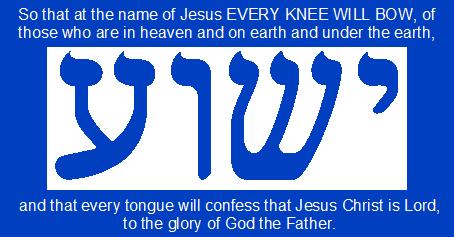


The entire passage ofg Philippians 2:5-11 has a distinct form of rhythmic prose, and it is considered by many scholars an Early Christian hymn, that Paul quoted. The version presented here is by NETBible, which I have chosen because of its fidelity to the original Greek:

5 You should have the same attitude toward one another that Christ Jesus had,1

6 who though he existed in the form of God3
did not regard equality with God
as something to be grasped,3a
7 but emptied himself3b
by taking on the form of a slave,4
by looking like other men,5
and by sharing in human nature.6
8 He humbled himself,
by becoming obedient to the point of death
– even death on a cross!
9 As a result God exalted him
and gave him the name6a
that is above every name,6b
10 so that at the name of Jesus [Yeshwah]
every knee will bow
– in heaven and on earth and under the earth –
11 and every tongue confess
that Jesus Christ is Lord
to the glory of God the Father.
(Philippians 2:5-11)

NOTES
(The notes that I have added here are my own, and only partly reflect the original NET © Notes.)
1 The literal translation is: “Have this attitude in/among yourselves which also [was] in Christ Jesus,” or “Have this attitude in/among yourselves which [you] also [have] in Christ Jesus.” The ambiguity is due to the fact that the verb (resp. "was" or "you have") is not present in the original Greek.
3 The Greek term translated form is μορφή (morphē - G3444) indicates a correspondence with reality, a "strong resemblance". The key to understanding this relationship between Jesus and God is to be found in another Greek word, λόγος (logos - G3056, lit. "word", "reason"), with which, in the Prologue of John's Gospel (John 1:1-18), Jesus is spoken of as the "Incarnated Word of God". For a discussion of the synonyms, see Trench's Synonyms, lxx. μορφή, σχῆμα, ἰδέα, in particular the second paragraph, where the different use of the words μορφή (morphē) and σχῆμα (schēma - G4976, habitus, "aspect", "fashion") in (Phil 2:6-8) is examined.
3a The Greek noun translated with the expression "something to be grasped" is ἁρπαγμός (harpagmos - G725), lit. "booty (of a robbery)". The sense of the whole v. 6 is that Jesus, although he had a divine nature, did not hold on to that "unfair advantage".
3b The Greek verb for emptied is κενόω (kenoō - G2758), lit. "to empty, make empty". The sense is, again, that Jesus, did not resort to the "unfair advantage" of his divinity, he laid aside his "form of God".
4 The Greek term translated as form is, again, μορφή (morphē - G3444). Jesus having laid aside his "form of God", appeared as the humblest of men, even a slave, a slave (or servant) of God, entirely bento on doing the Will of the LORD.
5 The Greek expression means, literally, "was made in the likeness of men". The Greek word is ὁμοίωμα (homoiōma - G3667). Jesus was "born of a woman", like any other man, although, of course, his conception was both mysterious and miraculous.
6 The Greek expression means, literally "was found [to be] in the fashion of men". The Greek word used here is σχῆμα (schēma - G4976, habitus, "aspect", "fashion"). Again nothing, externally distinguished him from all other men, except that he was sinless, as the Letter to the Hebrews says (Heb 4:15).
6a,b The twice repeated word "name" is, in Greek, ὄνομα (onoma - G3686), lit. "name", but also "rank", "title", so, "the name that is above every name" (το ονομα το υπερ παν ονομα, to onoma to yper pan onoma) can refer either to Yahweh, the Proper Name of God, or, more probably, as I believe, to His title, that appears at v. 11, Lord, κύριος (kyrios - G2962). After the supreme humiliation and abasement of the Cross, God exalted Jesus, His Messiah, His Son, the Incarnation of His Word, above all else, "so that at the name of Jesus every knee will bow – in heaven and on earth and under the earth – and every tongue confess that Jesus Christ is Lord to the glory of God the Father."

In conclusion
This hymn contains, in only 6 verses, the entire "career" of Jesus, his divinity, his incarnation, his humanity, his freely chosen humble status, his passion and death on the Cross, and finally his Resurrection, Ascension and Glory, "seated at the right of the Almighty".

The “unforgivable sin” is the “blasphemy against God's Holy Spirit”

Wednesday, October 14, 2009, 11:55 AM


("Now he was casting out a demon that was mute" - Luke 11:14)

What is the "unforgivable sin" (or "unpardonable sin" or "eternal sin")? Let's look at a safe source, the Scripture ... :

28 “Truly, I say to you, all sins will be forgiven the children of man, and whatever blasphemies they utter, 29 but whoever blasphemes against the Holy Spirit never has forgiveness, but is guilty of an eternal sin" (Mark 3:28-29 ESV)

30 Whoever is not with me is against me, and whoever does not gather with me scatters. 31 Therefore I tell you, every sin and blasphemy will be forgiven people, but the blasphemy against the Spirit will not be forgiven. 32 And whoever speaks a word against the Son of Man will be forgiven, but whoever speaks against the Holy Spirit will not be forgiven, either in this age or in the age to come. (Matthew 12:30-32 ESV)

10 And everyone who speaks a word against the Son of Man will be forgiven, but the one who blasphemes against the Holy Spirit will not be forgiven. (Luke 12:10 ESV)

So, unquestionably, all the three Synoptic Gospels agree that the "unforgivable sin" (or "unpardonable sin" or "eternal sin") is the blasphemy against God's Holy Spirit.

Can we admit that there is any difference between the Gospels, on such absolutely fundamental question? Of course not! Therefore ALL these expressions are absolutely equivalent ...

unforgivable sin = unpardonable sin = eternal sin = sin that leads to death = mortal sin

... and they all essentially consist in the blasphemy against God's Holy Spirit.

So, have we concluded our search? Not yet, because we have now to establish beyond doubt what is the "blasphemy against God's Holy Spirit".

Let's look again at a safe source, the Scripture. The answer comes from the "context" and it is, respectively, for Mark and Matthew constituted by ...

Mark 3:22-30 ("Blasphemy Against the Holy Spirit")

Matthew 12:22-32 ("Blasphemy Against the Holy Spirit")
 ... whereas, for some peculiar reason, Luke's material is arranged differently, so that the natural context of Luke 12:10 (corresponding to Mark and Matthew) is found at Luke, chapter 11:

Luke 11:14-23 ("Jesus and Beelzebul")

Now, if we compare Mark 3:22-30, Matthew 12:22-32 and Luke 11:14-23, it is immediately evident that (apart from the "re-placement" of Luke 12:10) they all speak of the same episode of Jesus casting our a demon. Let's look at it in detail in Luke's version:
Jesus and Beelzebul
14 Now he was casting out a demon that was mute. When the demon had gone out, the mute man spoke, and the people marveled. 15 But some of them said, “He casts out demons by Beelzebul, the prince of demons,” 16 while others, to test him, kept seeking from him a sign from heaven. 17 But he, knowing their thoughts, said to them, “Every kingdom divided against itself is laid waste, and a divided household falls. 18 And if Satan also is divided against himself, how will his kingdom stand? For you say that I cast out demons by Beelzebul. 19 And if I cast out demons by Beelzebul, by whom do your sons cast them out? Therefore they will be your judges. 20 But if it is by the finger of God that I cast out demons, then the kingdom of God has come upon you. 21 When a strong man, fully armed, guards his own palace, his goods are safe; 22 but when one stronger than he attacks him and overcomes him, he takes away his armor in which he trusted and divides his spoil. 23 Whoever is not with me is against me, and whoever does not gather with me scatters. (Luke 11:14-23)

What is the sin of the prejudiced enemies of Jesus, the Scribes and the Pharisees (and of whoever, misled by prejudice, "reasons" in bad faith like them)? The answer, by now, is straightforward: rather than admitting that Jesus was casting out the demon by the power of God's Holy Spirit, they were ready to affirm the absurdity that Jesus was casting out a demon by the power of Satan (or Beelzebul)

Conclusion

So, in conclusion, the Scriptures clearly support the exact opposite of what many believe:

The "unforgivable sin" is NOT, the "rejection of Jesus Christ" (and so says with crystal clarity Jesus himself), BUT the blasphemy against God's Holy Spirit, that is the refusal of recognizing God's presence at work, and the attribution of God's signs even to Satan, to Beelzebub.

This will come as a surprise to many, but it is the undeniable conclusion that we draw from the Gospels.

What is The Gospel of Jesus?

Sunday, October 11, 2009, 10:58 PM [General]


(The Sermon On the Mount by Carl Heinrich Bloch, d. 1890)

Before we attempt an answer, before someone comes up with some improper notion of "gospel", distinct from (but in fact, opposed to ...) Jesus' Gospel, let's do a bit of lexical inquiry (and then some inquiry on the NT use), and try to establish some points.

Lexical Exam

The English word "Gospel", "Middle English, comes from Old English gōdspel (ultimately translation of Greek euangelion) : gōd, good;  + spel, news" (The American Heritage® Dictionary of the English Language).

The Greek noun that (within the context of the NT) is translated in English as "gospel" (or, "good news") is εὐαγγέλιον (euaggelion - G2098).

The corresponding Greek verb (within the context of the NT) is εὐαγγελίζω (euaggelizō - G2097, "to bring good news", "to announce glad tidings").

It is interesting to notice that the active form of the verb (euaggelizō) is a late form, viz. only attested in the koine Greek, whereas classical Greek has only the form euaggelizomai (see LSJ, A Greek-English Lexicon), which is normally used as deponent (active meaning - passive form); as proper passive (of euaggelizō) it is ONLY attested in the NT. A further complication is in Luke, where we find euanggelizomai used both as deponent ("to proclaim good news" - Luke 4:43), and as passive ("the good news is proclaimed" - Luke 16:16).

The noun euaggelion, in the general context of Ancient Greek (see LSJ, A Greek-English Lexicon) has different meanings, which evolve in the course of time, and are reflected in its final adoption as "technical" Christian:

[A.] reward of good tidings, given to the messenger.

[II.] good tidings, good news, in which the idea of the reward is not (not necessarily) implied. In this sense we find it used in the LXX Septuagint. It is interesting to see it in conjunction with the Hebrew noun of which it is the translation (בשורה, bĕsowrah - H1309), and also with the corresponding Greek verb (euanggelizomai, deponent, "to bring good news") and with the relative Hebrew verb of which it is the translation (בשר, basar - H1319). In the Hebrew 2 Samuel 4:10, and in the relative Greek LXX, we find all these 4 forms:

[9 David replied to Recab and his brother Baanah, the sons of Rimmon the Beerothite, “As surely as the Lord lives, who has delivered my life from all adversity,] 10 when someone told me that Saul was dead – even though he thought he was bringing good news [basar, euanggelizomai] – I seized him and killed him in Ziklag. That was the [reward for the] good news [bĕsowrah, euaggelion] I gave to him!  (2 Sam 4:[9]-10)

Notice how David is making a (darkly ironic) play on words on the "reward" (death!) that he gave to the messenger in return for the "good news" of Saul's death.

[2.]  in Christian sense, the gospel, Ep.Gal.1.11, etc. [where euaggelion is used in a "technical", specialized sense; the process is similar to that undergone by the Greek word Χριστός (Christos -  G5547, "Christ"), which, in the beginning was a direct translation of the Hebrew title משיח (mashiyach - H4899, "Anointed, viz. King", "Messiah"), and then,already in Paul, was treated NOT as a title, but almost like a proper second name - or main name - of Jesus (Yehoshuah)]

Outline of Biblical Usage

The Greek noun εὐαγγέλιον (euaggelion - G2098, "gospel", "good news") is used a total of 74 times in the NT.

In the Four Gospels is only used by Matthew (4 times) and Mark (8). Luke never uses it in his Gospel (but we find it used in Acts - 2 times). John never uses it in his Gospel (we find it used in Revelation  - 1 time).

The NT author who used it by far the most is Paul (58 times).

It is attested in 1 Peter (1 time).

The Greek verb εὐαγγελίζω (euaggelizō - G2097, "to bring good news", "to announce glad tidings") is used a total of 52 times in the NT.

In the Four Gospels is only used by Matthew (1 time) and Luke (10). Luke also uses it extensively in Acts - 15 times. John, again, never uses it in his Gospel (we find it, though, used in Revelation  - 2 times).

Paul uses it 19 times throughout his Epistles.

It is also attested in Hebrews (2 times), and in 1 Peter (3 times).

What does Jesus mean by "gospel"?

A look at the use of the Greek words euaggelion and euaggelizō by Jesus throughout the Synoptic Gospels, makes us realize that:

* Until the turning point of Peter's Confession of the Messiahship of Jesus at Caesarea Philippi (Mat 16:13-20; Mar 8:27-30; Luk 9:18-21), the "gospel" ("good news", "good news of the kingdom") means essentially two inseparably joined notions:

§ Free forgiveness by God for all who truly repent.

§ Establishment of God's Kingdom (the Kindom of Heaven) on earth by the obedience of God's Commandment, the Great Commandment, the Law of Love.

* Only after Peter's Confession, Jesus' announcement of the "gospel" takes on the aspect of confrontation with the Jewish authorities, an apocalyptic aspect, and is joined with the inevitability of his passion and death.

What is the irony with the Gospel of Jesus?

What is ironic is that the authentic Gospel of Jesus (which, once again, was and is the "good news" of God's free forgiveness for all who truly repent, and of the establishment of God's Kingdom - the Kingdom of Heaven - on earth by the obedience of God's Commandment, the Great Commandment, the Law of Love), "Good News" in which Jesus' Passion and Death were NOT explicitly entailed, because of this inevitability of his passion and death (as Israel did NOT repent and obey), got distorted to the point that it was substituted, in particular by the Protestants, who misinterpreted Paul, with a "gospel" which:

# while it retained the faith in God free forgiveness for all who truly repent,

# OTOH associated this free forgiveness ONLY with the faith in the absolute efficacy of Jesus sacrifice, of Jesus atoning death, NOT with the necessary obedience to God's Law, the Law of Love.

Martin Luther's warped "gospel"

Thursday, October 8, 2009, 10:33 AM


Lucas Cranach the Elder, Crucifixion

Obeying the Law to "love thy neighbour" is the  "fulfillment of the Law", but it is also the hardest part of the Law. So hard, in fact that Martin Luther, the "Apostle of the Apostle", rejects even the very "New Law" that Jesus affirms, because, according to him, being spiritual, it is even more unattainable than the "Old Law" by the fallen humans that we are.

Essentially, Luther affirms that not only the literal Law of Moses, but even the spiritual Law of Jesus is not something to be fulfilled, but only something given to us to make us aware that only God's gratuitous grace justifies and saves us unconditionally. Here is what he says:
[Primum officium Euangeli] est interpretari legem veterem, ut Dominus Matth. 5. illud praeceptum ‘Non periurabis, non occides, non moechaberis’ interpretatur, et sic de literali in spiritualem intelligentiam transferre. […] Haec autem intelligentia legis spiritualiter multo magis occidit, quia facit legem impossibilem impletu ac per hoc hominem de suis viribus desperatum et humiliatum, quia nullus est sine ira, nullus sine concupiscentia: tales sumus ex nativitate.

[The first function of the Gospel] is to interpret the ancient Law, as the Lord [Jesus] interprets that precept in Matthew 5, ‘You shall not swear, you shall not murder, you shall not commit adultery’, so as to transfer us form a literal to a spiritual interpretation. [...] This interpretation of the law according to the spirit, though, is even more lethal, because it makes the Law impossible to fulfil, and as a consequence it makes man desperate about his own capacity, and humiliated, because nobody is without wrath, nobody without concupiscence: in fact that is the way we are from birth.

D. Martin Luthers Werke, Weimar, 1883-1983, (WA 1, 105, [#] 6-17) [translation from Latin to English MdS]
It cannot even be said, that, in this attitude towards the Law, Luther follows Paul ...

... all you have to do [to prove Luther's "biased reading and understanding of Paul"] is to put one after the other these two lines:

Paul: For the whole law is fulfilled in one word: “You shall love your neighbor as yourself.” (Gal 5:14; Rom 13:8)
Luther:  'because it is not necessary to fulfil [the law]', ‘quod non sit necesse [legem] implere’ (WA 1, 105, 19-28.37-38)

This is what Luther says [which proves that, for Luther, the Gospel, NOT Luther's "gospel", BUT Jesus' Gospel was "cacangelium", viz. "bad news"]:
Alienum autem Euangelii opus est parare Domino plebem perfectam, hoc est, peccata manifestare et reos arguere eos, qui iusti erant sibi, dum dicit, omnes esse peccatores et gratia Dei vacuos. Hoc autem pessimum nuntium videtur esse, unde potius cacangelium i.e. malum et triste nuntium dici possit.

The improper task of the Gospel is to prepare for the Lord a perfect assembly, that is, to make manifest their sins, and convince of guilt all those, who thought they were just, when it says,  that all are sinners and devoid of God's grace. This, though, seems to be the worst news, whereby, it would be more proper to call it cacangelium, that is bad and sad announcement. D. Martin Luthers Werke, Weimar, 1883-1983, (WA 1, 113, [#] 6-114, 34) [translation from Latin to English MdS]
So, what is Luther's solution, in front of the (asserted) impotence of men to obey NOT ONLY the literal Law of Moses, BUT EVEN the spiritual Law of Jesus? Simple! Total antinomianism: we can simply dump the Law, Old as well as New ...
'because it is not necessary to fulfil it', ‘quod non sit necesse eam implere’ (WA 1, 105, [#] 19-28.37-38)
So what is left for Luther of The Great Commandment, solemnly re-affirmend by Jesus? Essentially ... nothing.

The essential function of Jesus, for Luther is to be ... crucified.

P.S. The links are to the pages, [#] in Read Online format, of:
Werke. Kritische Gesamtausgabe. [Hrsg. von J.K.F. Knaake et al.] (1883)
Author: Luther, Martin, 1483-1546; Knaake, Joachim Karl Friedrich, 1835-1904
Volume: 01
Publisher: Weimar H. Böhlaus
Possible copyright status: NOT_IN_COPYRIGHT
Language: German
Call number: AAT-7219
Digitizing sponsor: msn
Book contributor: Robarts - University of Toronto
Collection: robarts; toronto

Peter's Denial(s)

Saturday, October 3, 2009, 11:25 AM


The episode of Peter's threefold denial needs to be examined in detail, before we can draw some conclusions.

First of all, in what it consists, (#) according to the Gospels (see Peter's Denial of Jesus, @ journal33.org), bearing in mind that John does not present them exactly in the same order, and other details, like the fire by which Peter was warming himself, or when and how many times "the rooster crowed" differ:

1. A denial when a female servant of the high priest spots Simon Peter, saying that he had been with Jesus. According to Mark (but not in all manuscripts), "the rooster crowed". Only Luke and John mention a fire by which Peter was warming himself among other people: according to Luke Peter was "sitting"; according to John, he was "standing". (Mat 26:69-70; Mar 14:66-68; Luk 22:54-57; Joh 18:15-18)

2. A denial when Simon Peter had gone out to the gateway, away from the firelight, but the same servant girl (Mark) or another servant girl (Matthew) or a man (Luke and also John, for whom, though, this is the third denial) told the bystanders he was a follower of Jesus. According to John, "the rooster crowed". (Mat 26:71-72; Mar 14:69-70; Luk 22:58; Joh 18:26-27)

3. A denial came when Peter's Galilean accent was taken as proof that he was indeed a disciple of Jesus. According to Matthew, Mark and Luke, "the rooster crowed". For John, though, this is the second denial, and he does not mention the Galilean accent. (Matt 26:73-75; Mar 14:70-72; Luke 22:59-62; John 18:25)

Second, can Peter's denials be put on a par with Judas' betrayal? No, for at least two reasons:

1. Peter's lies cannot be judged according to the commandment "You shall not bear false witness against your neighbor", because this commandment is not simply about "saying a lie", but whether this lie damages the neighbor. Now, while Peter's repeated denials were certainly lies, they could no more damage Jesus, because the damage was already done by Judas' betrayal.

2. Peter, unlike Judas, who, by his suicide showed that he had lost all hope in Jesus' forgiveness, not only immediately repented and "wept bitterly", but, after the Resurrection, was explicitly forgiven by Jesus.

Third, it is fundamental that, in three critical episodes, of which the second and the third are connected with Peter's Denials, Jesus attributed to Peter a special, unique commission, that of shepherd of his entire "flock".

a. near the end of the "Galilean Ministry", when Peter confesses Jesus as "the Messiah, the Son of the Living God":
Peter Confesses Jesus as the Christ
13 Now when Jesus came into the district of Caesarea Philippi, he asked his disciples, “Who do people say that the Son of Man is?” 14 And they said, “Some say John the Baptist, others say Elijah, and others Jeremiah or one of the prophets.” 15 He said to them, “But who do you say that I am?” 16 Simon Peter replied, “You are the Christ, the Son of the living God.” 17 And Jesus answered him, “Blessed are you, Simon Bar-Jonah! For flesh and blood has not revealed this to you, but my Father who is in heaven. 18 And I tell you, you are Peter, and on this rock I will build my church, and the gates of hell shall not prevail against it. 19 I will give you the keys of the kingdom of heaven, and whatever you bind on earth shall be bound in heaven, and whatever you loose on earth shall be loosed in heaven.” 20 Then he strictly charged the disciples to tell no one that he was the Christ. (Matthew 16:13-20)

b. During the last Supper, in the imminence of Jesus' Passion and Death:
Jesus Foretells Peter's Denial
31 “Simon, Simon, behold, Satan demanded to have you, [plural] that he might sift [you] like wheat, 32 but I have prayed for you [singular] that your faith may not fail. And when you have turned again, strengthen your brothers.” 33 Peter [he] said to him, “Lord, I am ready to go with you both to prison and to death.” 34 Jesus [he] said, “I tell you, Peter, the rooster will not crow this day, until you deny three times that you know me.” (Luke 22:31-34)

c. On the last encounter of the Resurrected Jesus with his Apostles, by the Sea of Tiberias:
Jesus and Peter
15 When they had finished breakfast, Jesus said to Simon Peter, “Simon, son of John, do you love me more than these?” He said to him, “Yes, Lord; you know that I love you.” He said to him, “Feed my lambs.” 16 He said to him a second time, “Simon, son of John, do you love me?” He said to him, “Yes, Lord; you know that I love you.” He said to him, “Tend my sheep.” 17 He said to him the third time, “Simon, son of John, do you love me?” Peter was grieved because he said to him the third time, “Do you love me?” and he said to him, “Lord, you know everything; you know that I love you.” Jesus said to him, “Feed my sheep. 18 Truly, truly, I say to you, when you were young, you used to dress yourself and walk wherever you wanted, but when you are old, you will stretch out your hands, and another will dress you and carry you where you do not want to go.” 19 (This he said to show by what kind of death he was to glorify God.) And after saying this he said to him, “Follow me.” (John 21:15-19)

There is no question that, in spite of Peter's many faults, Jesus wanted Simon Peter, whose Aramaic nickname was Kepha, rock, as the "rock" upon which he would build his Church; as the one, who better than any others, because he was aware of his weaknesses, would "strengthen the brothers" in their moments of weakness; as the one who, with his firm hand, would "feed his sheep".

NOTE
(#) Here are the links to the accounts of Peters Denials in the four Gospels:
Matthew 26:69-75
Mark 14:66-72
Luke 22:54-62
John 18:15-18, 25-27

As can be seen, unlike all the synoptics, which provide a seamless occount of the threefold denial, in John's Gospel, between the two accounts of Peter's Denials (Peter Denies Jesus, Peter Denies Jesus Again), we find The High Priest Questions Jesus (John 18:19-24)

Antichrists: "those who do not confess the coming of Jesus Christ in the flesh"

Friday, September 11, 2009, 7:15 AM


Deeds of the Antichrist (Luca Signorelli, c.1501, Orvieto Cathedral, detail).

The word αντιχριστος (antichristos - G500, "antichrist"), in the Greek language, is used only 5 times, and all of them in the Epistles of John.

Let's examine the relevant verses:
[1] Children, it is the last hour, and just as you heard that the antichrist is coming, so now many antichrists have appeared. We know from this that it is the last hour. (1Jo 2:18)
[2] Who is the liar but the person who denies that Jesus is the Christ? This one is the antichrist: the person who denies the Father and the Son. (1Jo 2:22)
[3] ... but every spirit that does not confess Jesus is not from God, and this is the spirit of the antichrist, which you have heard is coming, and now is already in the world.(1Jo 4:3)
[4] For many deceivers have gone out into the world, people who do not confess Jesus as Christ coming in the flesh. This person is the deceiver and the antichrist! (2Jo 1:7)
[emphasis MdS]
In what exactly consists being "antichrist"? We can say (in agreement with 1Jo 2:22) that an "antichrist" is one "who denies that Jesus is the Christ" (that is the Messiah), and that should be enough, as even the etymology of the word "anti-Christ" suggests: αντι (anti) = "against". But then why (again, according to 1Jo 2:22) we read "and thus denies the Father and the Son". Why "thus"? What is the connection between ...
[2a] "denying that Jesus is the Christ"
and
[2b] "denying the Father and the Son"
Shouldn't [2a] be enough, as definition of "antichrist"? If not, why not?
And what does [2b], "denying the Father and the Son", mean, anyway?
The only way to answer these questions, who is "the antichrist" and what exactly is the "the spirit of the antichrist", is to examine the above four verses, exactly as they appear in their sequence.
[1] 1Jo 2:18 is a warning: it says that "the antichrist is coming" and says that the "symptom" is that "many antichrists have appeared", but does NOT explain who "the antichrist" is and what "the spirit of the antichrist" is about.
[2] 1Jo 2:22 is more specific: it says, essentially that "who denies that Jesus is the Christ" is "the liar", and that would seem enough as a definition, but then, immediately after, we find a puzzling addition: "the antichrist" is "the person who denies the Father and the Son". What has "denying the Father and the Son" got to do with "denying that Jesus is the Christ" (the Messiah)? Can it be meant in a trinitarian sense? This would not only be anachronistic, but also it would be most confusing: what is the connection between Jesus being the Christ (the Messiah) and him being the "Son of the Father"? And if "Son" is NOT meant in a trinitarian sense, is it meant in a metaphoric sense, like in Luke 3:38 ("... Adam, the son of God")? Or is it meant in the sense of the high dignity of the Anointed King of God, like in Psalm 2:7 ("He [the Lord] said to me, “You are my Son; today I have begotten you.”")? None of this seems sufficient to account for the specific expression "denies the Father and the Son".
[3] 1Jo 4:3, funnily enough, seems even less clear than 1Jo 2:22, because it simply says that "every spirit that does not confess Jesus is not from God" and that this is "the spirit of the antichrist". It doesn't not even say "Jesus Christ" or "Jesus the Christ", nor does it refer to "denying the Father and the Son", like the previous verse. But the key to the full understanding of 1Jo 4:3 is (quite obviously, actually) to read it in conjunction with the verse immediately preceding it:
2 By this you know the Spirit of God: Every spirit that confesses Jesus as the Christ who has come in the flesh is from God, 4:3 but every spirit that does not confess Jesus is not from God, and this is the spirit of the antichrist, which you have heard is coming, and now is already in the world.(1Jo 4:2-3 - emphasis MdS)
So here, for the first time, we find, in positive terms, what is the right "confession" about Jesus: NOT ONLY that he is the Christ (the Messiah), BUT ALSO that "Jesus is the Christ who has come in the flesh".
This expression is fundamental for two reasons:
[3.1] It affirms, against the spreading of the docetic "doctrine" of "christian" Gnosticism, that Jesus, while having divine nature, has ALSO a full human nature, that he is naturally "born of a woman", that his physical body is NOT an illusion but a real, natural body, like that of any human being, actually, as he was a man (not a woman or an androgynous, or a sexless being), of any man. It is almost certain that this (docetism) was precisely the heresy, nay the apostasy of some members of John's community, that ultimately led them to abandoning the community (1Jo 2:19), because their belief system about Jesus (original? mutated?) is incompatible with Christianity.
[3.2] It is a key to explaining the expression "denying the Father and the Son": NOT in the trinitarian sense, BUT in the plain sense that Jesus is, literally, the Son of YHWH God, the One and Only, the Father Almighty, "conceived by the Holy Spirit, born of the Virgin Mary", exactly as the Apostles' Creed says, on the firm ground of the Gospel of Luke:
The angel replied, “The Holy Spirit will come upon you, and the power of the Most High will overshadow you. Therefore the child to be born will be holy; he will be called the Son of God. (Luke 1:35)
[4] 2Jo 1:7 solemnly and synthetically reaffirms what is said at 1Jo 4:2-3: "those who do not confess the coming of Jesus Christ in the flesh", "such a one is the deceiver and the antichrist".

In conclusion:
The antichrist is he who does NOT confess the coming of Jesus Christ in the flesh, viz. that Jesus Christ, the Messiah, is the Son of God, in the plain sense that Jesus is, literally, the Son of YHWH God, the One and Only, the Father Almighty, "come in the flesh", that is "conceived by the Holy Spirit, born of the Virgin Mary".

Abraham's Temptation: a matter of Faith, Hope and Love

Thursday, January 22, 2009, 11:12 AM


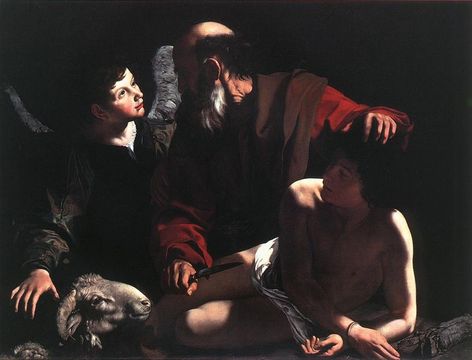
The Sacrifice of Isaac, Caravaggio, 1598

God's Covenant with Abram (Genesis 15) is a real proper Covenant, that is bilateral (NOT unilateral), with the added specification that it is asymmetric.
.
It is a sign of great confusion to resort to the philosophical lucubrations of a secular philosopher, however great, like Immanuel Kant ...
"If God should really speak to man, man could still never know that it was God speaking. It is quite impossible for man to apprehend the infinite by his senses, distinguish it from sensible beings, and recognize it as such. But in some cases man can be sure the voice he hears is not God’s. For if the voice commands him to do something contrary to moral law, then no matter how majestic the apparition may be, and no matter how it may seem to surpass the whole of nature, he must consider it an illusion." --Immanuel Kant, in The Conflict of the Faculties, p. 115

... and to oppose them to the totally unambiguous and crystal clear text of the Bible (Gen 22:1-2; 15-18)
.
Abraham's Trial is a true trial (test, temptation) of Abraham by God, to test his faithfulness to the Covenant and his obedience to the LORD (see previous post Abraham's Temptation: only a matter of Faith, or also of Hope?)
"There is definitely an implied requirement that Abraham have faith in God, and that is all that is required to have a mutual agreement, a covenant"
Genesis 22:2, as well as Genesis 22:16-18 are to be read at face value, viz. as a command that the Lord actually gave to Abraham, and as God's approval of Abraham for "passing the test" as even simply prudent ex-exesis would dictate.
.
The Covenant that God established with Abram/Abraham (once again, bilateral, with the added specification that it is asymmetric) assumes the form of the ancient rite of “covenant between the pieces” (see Genesis 15). God's commitment is unconditional on His part: the LORD is the only one who "walks between the pieces" and who, paradoxically, pledges Himself symbolically to be "cut in half" if He does not keep his promise.
.
While God's commitment to the Covenant is unconditional, this does not imply that there are not obligations for Abraham. They are summed up as faithfulness to the covenant and obedience to an explicit command of God, which is a true an proper "stipulation for Abram: “I am God Almighty; [Hbr: El Shaddai] walk before me [“serve me faithfully”] and be blameless ...” (Genesis 17:1) and is expressed symbolically by the circumcision 
.
Abraham's feeling of 'obligation' when he is "put to the test", that is, his motivation for being ready to sacrifice his own son has nothing whatsoever to do with a presumed "predisposition ... originated in his own mind from his culture" and "inclinations based on his cultural background". In particular Abraham was not mislead by a supposed "ill-inspired initiative to please the LORD", adopting the idolatrous and deviated sacrificial practices in existence in the land where he came from ("Ur of the Chaldeans"), transited through (Haran, Egypt) and eventually settled in (Canaan) where human sacrifice, and in particular the sacrifice of children was practiced.
.
The LORD had gradually established in and with Abram/Abraham, by the time of His Temptation, enough trust to expect that Abraham would respond in the only possible way, however anguishing, that is with obedience. Abraham proved by his behaviour that he had enough Love (that is obedience) for God and, at the same time for his son Isaac (the "son of the promise", whom he owed entirely to God's miraculous intervention) to respond to God's request with Faith and Hope. (see previous post Abraham's Temptation: only a matter of Faith, or also of Hope?)
.
God did NOT lie to Abraham about his request of sacrifice: he ONLY affirmed His own right to test, in His Omnipotence, even Abraham's readiness to offer his own child Isaac (who, again, was entirely the fruit that Abraham owed to God's miraculous intervention): it was a a true trial (test, temptation), and God could rightfully assume that Abraham had, by then, acquired enough Faith and Hope in Him to "take the risk" of Obeying unconditionally.
.
Genesis 15 and Jeremiah 34:18,19 are the most relevant (and specular) examples of bilateral Covenant in the OT, where God and humans are involved (see SMITH comment on "Covenant" at NETBible). In the former it is the LORD who pledges Himself unconditionally, ONLY God "passed between the pieces". In the latter it is the "the leaders of Judah and Jerusalem, the court officials, the priests, and all the other people of the land", ONLY men "passed between the parts of the calf" "before God".
.
Abraham, who was faithful ad obedient to God like a servant, did NOT behave with the motivations of a servant, but out Faith,  Hope and  Love. That is why he is, rightfully, the only one to be called "friend of God"(James 2:21-23)
.
That Abraham responds with Faith and Hope  to the request of the LORD to offer Isaac in sacrifice as a test, is confirmed beyond doubt by this fundamental verse: Then Abraham said to his young men, “Stay here with the donkey; I and the boy will go over there and worship and come again to you.” (Gen 22:5) (#)
.
That "Abraham's Trial" is a genuine trial (test, temptation) both for God who initiates it, and for Abraham who responds to it, depends essentially on the fact that Abraham enjoyed genuine human freedom, which would have been incompatible with God's absolute foreknowledge.
.
Abraham's faithfulness and obedience truly express themselves in Abraham's response to God's request, that is in his offer to sacrifice his son Isaac.

NOTE
(#) Some have interpreted this passage of Hebrews ...
17 By faith Abraham, when he was tested, offered up Isaac, and he who had received the promises was in the act of offering up his only son,   18 of whom it was said, “Through Isaac shall your offspring be named.”  19 He considered that God was able even to raise him from the dead, from which, figuratively speaking, he did receive him back. (Heb 11:17-19)
... to mean that, if ever God had indeed required Isaac’s death, God would have returned Isaac to Abraham by way of resurrection.
While I am perfectly aware of what the author of Hebrews says, it is definitely far-fetched to attribute to Abraham the belief that, if the Mysterious God really  wanted him to go all the way with the sacrifice (slaughtering his son Isaac and burning him to ashes), he overcame that thought, because "He considered that God was able even to raise him from the dead".
There is no serious ground to infer that, at that initial stage of God's revelation, Abraham could possibly think of the resurrection of the dead.
It is evident that this is ONLY a rhetoric figure, on the part of the author of Hebrews, so as to introduce the second (and most relevant) part of the verse: "from which [the dead], figuratively speaking, he did receive him back." (Hebrews 11:9).
The author of Hebrews is clearly speaking in figure: what he is saying is that it is as though Abraham, through his faith and his obedience, approved by God (Gen 22:12,16), had received Isaac back, because only "hoping against hope" could he possibly "know" that God would have stopped short of letting him go through with the sacrifice.
To understand the essential role of hope in Abraham's Trial, Paul, with his Epistle to the Romans is of much more help than the Epistle to the Hebrews:
 In hope he [Abraham] believed against hope, that he should become the father of many nations, as he had been told, “So shall your offspring be.” (Romans 4:18 - ESV - emphasis MdS)