Sunday, 31 January 2016

"Begotten before all ages"? Bah ...

(Wednesday, April 11, 2012, 6:40 AM)



That the clause "[begotten] before all ages" was craftily added to the original Nicene Creed of 325 AD is evident from the comparison between Creed of 325 and Creed of 381.

Let's now get to the bottom of this "before all ages" thingy.

First, that the "before all ages" clause did NOT exist in the original Nicene Creed of 325, is a fact. It was ONLY added at  Constantinople in 381 (if not even later ...) because the Conciliar Fathers  needed to add it, so as to sanction, with a collective sleigh of hand, an "official" understanding of the godhead that had completely changed over the 4th  century.

Second, it may come as a surprise to many that the "before all ages" clause first appeared where one would never expect to see it, in Arius' own letter to Constantine in 327 (Arius' Letter to the Emperor Constantine, 327 CE, NPNF2-02, The Ecclesiastical History of Sozomen, Book IIChapter XXVII @ ccel.org ], a "creed" compiled by Arius and his crony, deacon and supporter  Euzoïus, apparently along the lines of the Nicene Creed of 325, which easily procured for them the return from exile and the return in the  favor of Emperor Constantine, which should prove how irrelevant was the Nicene Creed for the purpose for  which it was officially defined: the definitive quashing of the Arian heresy.

Third, several "creeds" were written in the period between 325 and 381 (as A Chronology of the Arian Controversy, @ http://legalhistorysources.com, attests). By the time of the Synod of Alexandria  (362), when the wind changed for the Arian party, there were as many as eleven (11!!!) Arian "confessions" (see The Eleven Arian Confessions, @ arian-catholic.org: the Eleventh Arian Confession is of 361 AD), most of which included the "before all ages" clause.

Of course by the time of the Council of Constantinople (381 AD), the "before all ages" had sunk in: either by persuasion, or by exhaustion, or by political compromise.

Paul and the Mosaic Law (Paul and the circumcision)

(Friday, December 2, 2011, 9:13 AM)


Valentin de Boulogne, Saint Paul writing his Epistles, c. 1600

It is obvious, that Paul did NOT consider the obedience to the Mosaic Law, in all its details (first and foremost the circumcision, key symbol and distinction of the Jews vs the Gentiles), essential for salvation.

This is crystal clear from plenty of passages from his letters. I believe these two will do:

Circumcision is nothing and uncircumcision is nothing. Instead, keeping God’s commandments is what counts. (1 Cor 7:19)

For circumcision has its value if you practice the law, but if you break the law, your circumcision has become uncircumcision. (Rom 2:25)

Now, what "God’s commandments" is Paul referring to, and what "law"? Obviously NOT the detailed 613 commandments (613 mitzvot) contained in the Torah, because the circumcision is, once again, one of them, nay the key symbol of the Mosaic Law (see Gen 17:10-14; Lev 12:3; see also Wikipedia > Brit milah).

So, what God's Commandments, of what Law? Essentially, just one: The Greatest Commandment (see Mark 12:28-31; cp. Deut 6:4-5, Lev 19:18), of the Law of Love. See here:

Owe no one anything, except to love one another, for the one who loves his neighbor has fulfilled the law. (Rom 13:8)

For in Christ Jesus neither circumcision nor uncircumcision carries any weight – the only thing that matters is faith working through love. (Gal 5:6)

Does this mean that Paul was against the respect of the Mosaic Law for the Jews, who had been brought up in its detailed obedience? Not at all! See the first verse that I quoted in its context:

18 Was anyone called after he had been circumcised? He should not try to undo his circumcision. Was anyone called who is uncircumcised? He should not get circumcised. 19 Circumcision is nothing and uncircumcision is nothing. Instead, keeping God’s commandments is what counts. 20 Let each one remain in that situation in life in which he was called. (1Cor 7:18-20)

The Transfiguration is a vision ...

(Sunday, November 20, 2011, 3:53 PM)


Giovanni Bellini, Transfiguration of Christ, c. 1487-1495, Naples

The Transfiguration (Matt 17:1-13; cp. Mar 9:2-13) is a vision, an eschatological vision, that Jesus gave the privilege of enjoying to the "inner circle" of his Apostles, Peter, James and John, so that their faith would not abandon them with the apparent total failure on the cross of Jesus Messianic mission, especially as Peter, just "six days earlier", had solemnly proclaimed Jesus as the Messiah (Matt 16:16).

That it was a vision is confirmed by some considerations and details:

Jesus had already pre-announced this vision, when, after Peter's solemn messianic proclamation and his own immediate reply (so disturbing to the Apostles - and to Peter in particular - with the prediction of the Cross  - Matt 16:21) he had promised,

“I tell you the truth, there are some standing here who will not  experience death before they see the Son of Man coming in his kingdom.” (Matt 16:28).

In spite of the rather shrouded words, this verse is an allusion to the Transfiguration.

The figures of Moses and Elijah, together represent perfectly the "Law and Prophets" that Jesus announced he was to fulfill (see Matt 5:17; 7:12; 11:13; 22:40; Luke 16:16; 24:44; John 1:45);

The vision disappears all of a sudden, as soon as Jesus "touches them" (Matt 17:7-8; cp. Mar 9:8);

"As they were coming down from the mountain", Jesus explicitly calls it a a vision (Greek: orama - Matt 17:9), to be kept as a secret for this "inner circle" of his Apostles.

In conclusion, everything is in favour of a vision, and ONLY "metaphysical prejudice", that simple Jewish fishermen from Galilee of the time of Jesus, like Peter, James and John certainly did not share, is in favour of Moses and Elijah as "living disembodied souls".

Science, fundamentally, is a game ...

(Sunday, August 7, 2011, 4:43 PM)


Science most certainly is NOT (should NOT be ...) a religion, BUT a "game", with an overarching rule, "methodological naturalism/materialism" of which Dickerson's "Rule No. 1", by far the best formulation
Science, fundamentally, is a game. It is a game with one overriding and defining rule:
Rule No.1: Let us see how far and to what extent we can explain the behavior of     the physical and material universe in terms of purely physical and   material causes, without invoking the supernatural.
Operational science takes no position about the existence or non-existence of the supernatural; only that this factor is not to be invoked in  scientific explanations. Calling down special-purpose miracles as  explanations   constitutes a form of intellectual "cheating."
(Richard E. Dickerson, The Game of Science: Reflections After Arguing With Some Rather Overwrought People, 1992, @ asa3.org)
Many people, though, confuse methodological naturalism/materialism with metaphysical naturalism/materialism.

Necessity, chance and free agency

(Sunday, July 3, 2011, 6:19 AM)


Taxonomy of Determinism and Indeterminism (source: History of the Free Will Problem, @ informationphilosopher.com)

According to Wikipedia,

Determinism is the general philosophical thesis that states that for everything that happens there are conditions such that, given them, nothing else could happen. (...)

Determinism is also the name of a broader philosophical view, which conjectures that every type of event, including human cognition (behaviour, decision, and action) is causally determined by previous events.

In philosophical arguments, the concept of determinism in the domain of human action is often contrasted with free will. The argument called indeterminism (otherwise "nondeterminism") negates deterministic causality as a factor and opposes the deterministic argument.

Determinists believe any determined system is fully governed by causal laws resulting in only one possible state at any point in time.

-- Wikipedia > Determinism

OTOH, we find in Aristotle a clear distinction between three types of causation:

1. Necessity (Greek ἀνάγκη, anankê): deterministic causality or, simply determinism.

2. Chance (Greek τύχη, tychê ): indeterministic causality or, simply indeterminism.

3. Agency of a free agent: what Aristotle says depends "on us" (ἐφ' ἡμῖν, eph'êmin  ).

Agent causation is therefore a "third thing" (tertium quid), beyond necessity and chance, that causes events or chains of events.

Aristotle clearly affirms the distinction between chance and necessity:

Nor is there any definite cause for an accident, but only chance (τυχόν), namely an indefinite (ἀόριστον) cause. (Metaphysics, Book V, 1025a25)

It is obvious that there are principles and causes which are generable and destructible apart from the actual processes of generation and destruction; for if this is not true, everything will be of necessity: that is, if there must necessarily be some cause, other than accidental, of that which is generated and destroyed. Will this be, or not? Yes, if this happens; otherwise not. (Metaphysics, Book VI, 1027a29)

He also clearly affirms the notion of agency and of free agent:

But if it is manifest that a man is the author of his own actions, and if we are unable to trace our conduct back to any other origins than those within ourselves, then actions of which the origins are within us, themselves depend upon us, and are voluntary. (Nicomachean Ethics, III, v, 6, Loeb translation)

But it is Epicurus (born 43 years after Aristotle) who summarized this triple classification of causality in the clearest and most essential way:

... some things happen of necessity, others by chance, others through our own agency [Greek: παρ’ ἡμᾶς (par'êmas), literally "by us"]. ... necessity destroys responsibility and chance is inconstant [Greek: ἄστατος (astatos): also unstable, uncertain]; whereas our own actions are autonomous, and it is to them that praise and blame naturally attach. (Epicurus, Letter to Menoeceus [§133], @ epicurus.net - bold by MdS)

This clear affirmation of agent causation and free will is surprising to most people, who are not familiar with Epicurus' own thought directly, but rather with its "vulgate" by the Latin poet Lucretius (see On the Nature of Things, 2.251-262, 289-293, @ perseus.tufts.edu)

In spite of Aristotle's and Epicurus' early and clear affirmation of agent causation and free will, most of the following philosophical thought seems to consider only the extreme positions of Determinism (an consequent incompatibilism) and Indeterminism (and consequent a-causalism).

This is a recent comment by Bob Doyle ("scientist, inventor, and philosopher") on the state of the problem:

Why have most philosophers been unable for millenia to see that the common sense view of human freedom is correct? It is partly because their logic and language preoccupation likes to say that either determinism or indeterminism is true, and the other must be false.

Determinism and indeterminism are the horns of the dilemma presented as the standard argument against free will, which we can trace back unchanged to the earliest discussions of freedom, determinism, and moral responsibility.

Our physical world includes both, though the determinism we have is only an adequate description for large objects. So any intelligible explanation for free will must include both a limited indeterminism and an adequate determinism, in a temporal sequence that creates information.

I believe that Doyle's approach may well be the closest we have to an explanation of agent causation and free will (between the two "horns" of Determinism and indeterminism) that is consistent with philosophy, science and also theology.

Saturday, 30 January 2016

The suffering servant of Yahweh

(Friday, June 24, 2011, 5:10 PM)


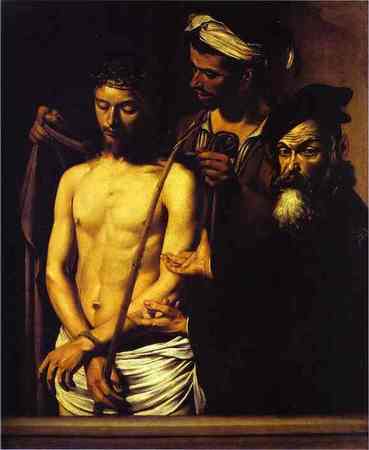
Ecce Homo by Caravaggio (1606)

The Servant songs (also called the Servant poems or the Songs of the Suffering Servant) are four songs in the Book of Isaiah in the Hebrew Bible, which include Isaiah 42:1-4; Isaiah 49:1-6; Isaiah 50:4-7; and Isaiah 52:13-53:12. They were first identified by Bernhard Duhm in his 1892 commentary on Isaiah.[1] The songs are four poems written about a certain "servant of YHWH." God calls the servant to lead the nations, but the servant is horribly abused among them. In the end, he is rewarded.
-- Wikipedia > Servant songs

Not only Jewish theologians, but many scholars consider the "Suffering Servant" a metaphorical and collective image for the entire nation of Israel.

I really don't see, though, how the following emphasized expressions would fit Israel, as a collective "messianic entity", rather than the Messiah as an individual person.

The Lord Will Vindicate His Servant
13 “Look, my servant will succeed!
He will be elevated, lifted high, and greatly exalted –
14 (just as many were horrified by the sight of you)
he was so disfigured he no longer looked like a man;
15 his form was so marred he no longer looked human
so now he will startle many nations.
Kings will be shocked by his exaltation,
for they will witness something unannounced to them,
and they will understand something they had not heard about.
1 Who would have believed what we just heard?
When was the Lord’s power revealed through him?
2 He sprouted up like a twig before God,
like a root out of parched soil;
he had no stately form or majesty that might catch our attention,
no special appearance that we should want to follow him.
3 He was despised and rejected by people,
one who experienced pain and was acquainted with illness;
people hid their faces from him;
he was despised, and we considered him insignificant.
4 But he lifted up our illnesses,
he carried our pain;
even though we thought he was being punished,
attacked by God, and afflicted for something he had done.
5 He was wounded because of our rebellious deeds,
crushed because of our sins;
he endured punishment that made us well;
because of his wounds we have been healed.
6 All of us had wandered off like sheep;
each of us had strayed off on his own path,
but the Lord caused the sin of all of us to attack him.
7 He was treated harshly and afflicted,
but he did not even open his mouth.
Like a lamb led to the slaughtering block,
like a sheep silent before her shearers,
he did not even open his mouth.
8 He was led away after an unjust trial
but who even cared?
Indeed, he was cut off from the land of the living;
because of the rebellion of his own people he was wounded.
9 They intended to bury him with criminals,
but he ended up in a rich man’s tomb,
because he had committed no violent deeds,
nor had he spoken deceitfully.
10 Though the Lord desired to crush him and make him ill,
once restitution is made,
he will see descendants and enjoy long life,
and the Lord’s purpose will be accomplished through him.
11 Having suffered, he will reflect on his work,
he will be satisfied when he understands what he has done.
“My servant will acquit many,
for he carried their sins.
12 So I will assign him a portion with the multitudes,
he will divide the spoils of victory with the powerful,
because he willingly submitted to death
and was numbered with the rebels,
when he lifted up the sin of many
and intervened on behalf of the rebels.”
(Isaiah 52:13-53:12 - emphasis MdS - cp. Yeshayahu Ch. 52:13-15, 53:1-12 @ chabad.org)

Only by very strained and artificial exegesis and hermeneutics, I believe, one could do that ...

Besided, most Biblical scholars agree in considering that the  "Servant Songs", the passages relative to the "Suffering Servant", the  "Servant of the Lord", the עַבְדָּא יְהֹוָה, the`Abad' YHWH are this (and only this) series of four passages (Isaiah 42:1-7; 49:1-13; 50:4-11; 52:13-53:12). So, other passages, like  Isaiah 41:8,9 and 44:1,2,21,  while they certainly speak of Israel/Jacob as "servant" and can  certainly, and most naturally be referred to Israel in a collective  sense, are NOT part of the "Servant Songs", for which this collective interpretation of the Israel/servant if far more problematic (see above).

Jesus, the "good thief", paradise and resurrection (Luke 23:42-43)

(Friday, June 10, 2011, 11:15 AM)


Titian (c. 1490-1576), Jesus Christ and the Good Thief, c. 1563

Jesus' Resurrection is something serious, NOT the charade that make of it those who affirm that he was already in "paradise", in the company of the "good thief", the very day that he was dead, without either of them having to wait for the resurrection to be alive again.

The promise of Jesus to the "good thief" (“I tell you the truth, today you will be with me in paradise.” - Luke 23:43) is NOT the promise that they will meet as blessed "disembodied souls" in "paradise" on that very day, immediately after death, but the promise that "even on that very day, he would be counted among the righteous in Paradise [that is in the "book" where the names of the righteous are written], awaiting the resurrection with them" (see The Comma of Luke 23:43, @ gci.org), awaiting for the day when Jesus will return in his glory, "in his kingdom" (Luke 23:42). Very much in the same sense as, in another famous Lucan passage, it is written:

18 So he said to them, “I saw Satan fall like lightning from heaven. 19 Look, I have given you authority to  tread on snakes and scorpions and on the full force of the enemy, and  nothing will hurt you. 20 Nevertheless, do not rejoice that the spirits submit to you, but rejoice that your names stand written in heaven.” (Luke 10:18-20 - emphasis MdS)

Once again, before he was raised from the dead, Jesus was truly ... dead, so, the first occasion he had of meeting anybody before his ascension, was, in any case, after his resurrection.